de NX9O, Brian
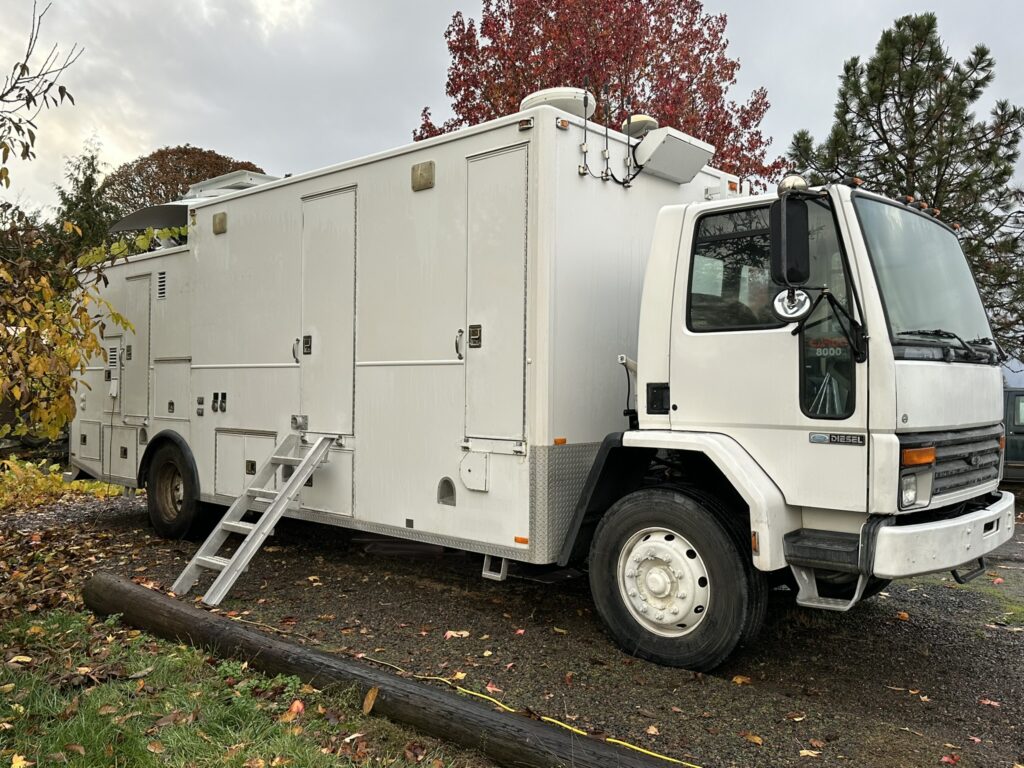
Passenger side view of LunaTruck with a stairway hung at the main door.
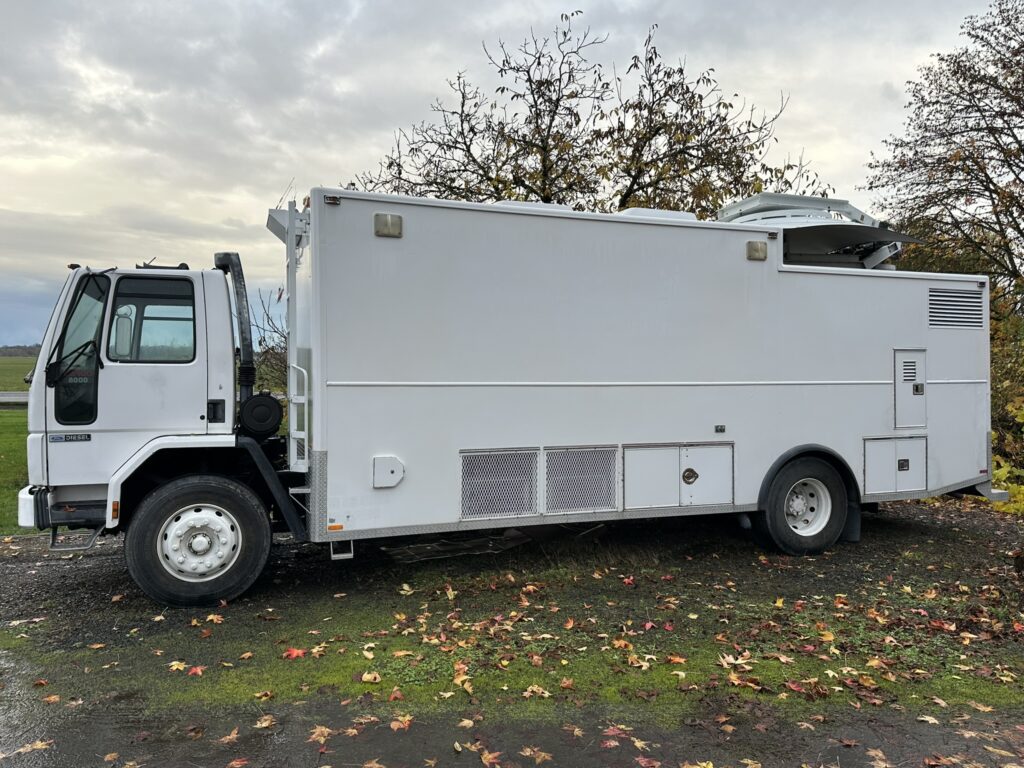
Driver side view of LunaTruck.
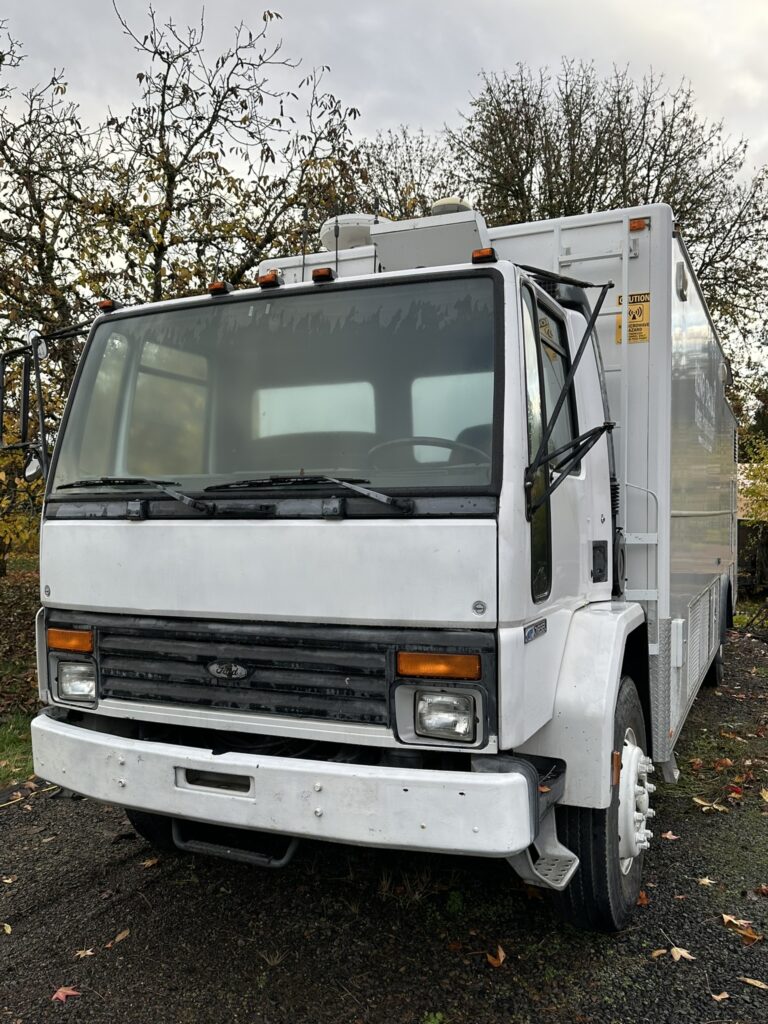
Front end of LunaTruck.
LunaTruck is a former Ku band TV satellite uplink truck. It had video and audio switching capability and could uplink HD video (with stereo audio) on 14GHz to geosynchronous satellites. It had 11GHz downlink capability. In these modern days of fiber connections becoming more common as well as StarLink and others becoming available everywhere, trucks like this are rarely needed. This one appeared on eBay and I eventually worked out a deal to purchase it and have it shipped up to Oregon from Reno, Nevada.
Some statistics and details:
- Total length 32 feet (10 meters)
- Gross Vehicle Weight Rating 33,000 lbs (15,000 Kg)
- Chassis is a 1992 Ford CF-8000, 7.8-liter diesel engine (475 cubic inches)
- Manual 5 speed transmission, with 2 speed manual shift rear differential
- Commercial truck style airbrakes
- Legal seating up front for 3 people if needed.
- 20KW Generac/Cummins diesel generator 120/240VAC in the back
- Two 50-gallon (190 liters) fuel tanks shared commonly between the engine & generator
- Plenty of heating and air conditioning
- Lots of power distribution in and out of the vehicle
- Hydraulic leveling jacks with a control station behind a locking passenger side door
- Lots of storage spaces
- 2 Traveling Wave Tube amplifiers each rated for 300w output on 14GHz
- A “baseball” switch system that seems to be able to select one or both amplifiers for transmission through the waveguide up to the dish with a local dummy load.
- Andrew 2.3/2.4m offset feed dish assembly that folds forward for travel
- All the antenna steering and control hardware is still in place and mostly working. The azimuth “resolver” is not working. It stopped working after an inexperienced operator drove the system past the rotation limit. Could it just be wiring?
- All the WR75 waveguides are still in place with flex couplings to the feed
- The single feed was used for RX on 11-12GHz and TX on 14-15GHz. Maybe there is a chance it might tune to 10GHz. (Maybe a long shot, but I will try it.)
- It had at least 4 older analog cellular telephones and an INMARSAT phone. The satellite phone antenna is still mounted.
I cannot be certain how much cabling I have already removed. It is likely at least 300 pounds and probably more. It is a pity that much of it is 75Ω coax. I have removed three heavy panels that made the middle supports of the front five 19” equipment racks. The rear racks are still in place and ½ full of patch panels, video matrix switches, and more cables.
Why did I send it to Oregon? To get it converted from a commercial truck to an RV on the insurance, license, and title. I have been successful in obtaining affordable insurance. I was about to take it to an Oregon DMV office for the required VIN inspection, but the driver side mirror fell off in my hands and I had run out of time in November, 2024. I had an appointment to activate 902MHz EME in Washington.
What am I hoping to do with it? My first goal is to turn it into a 10GHz EME rover. The TWTs should be able to tune down to 10GHz. Even if I only get 100w out of one of them, that will still be a big signal on 10GHz EME. I really believe it will be possible to fit more bands into LunaTruck. I have most of the hardware needed for 5GHz and some for 3400MHz. After attending Microwave Update 2024, I was convinced to add 24Ghz to my goals. With a solid aluminum dish surface already qualified to 14GHz, the performance on 24GHz should be reasonable.
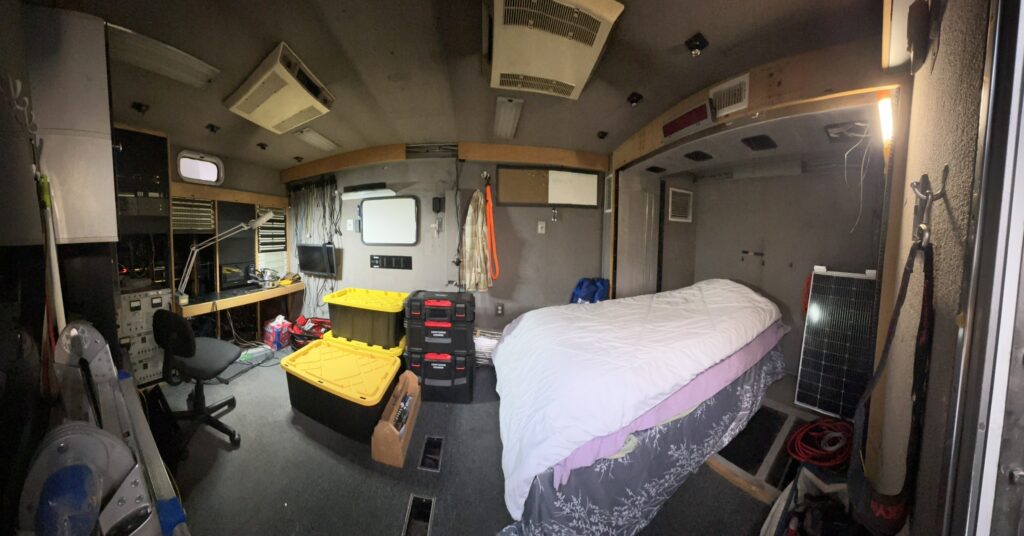
This is panorama of what it looks like inside currently.
The TWTs are toward the bottom of the left most rack. Just above them is the “baseball” switch. There is some open rack space, a spectrum analyzer, the antenna control box, and near the top of that rack are switches for controlling the 11GHz RX chain. The solar panels all the way to the right were set on top of the truck and connected to a charge controller to keep the three 12VDC AGM batteries topped off while I was away. Also visible on the ceiling are two rooftop air conditioners.
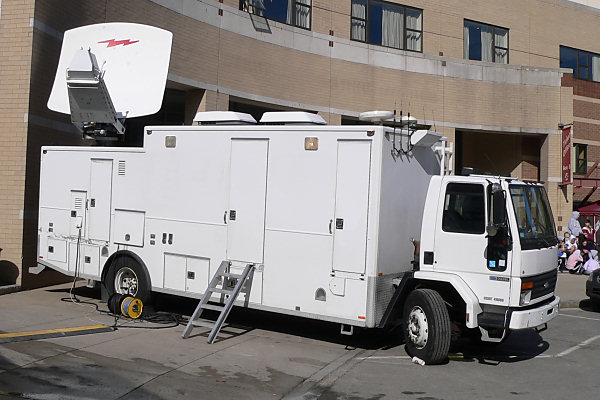
This is an older photo of what it looked like much earlier in its history while working.
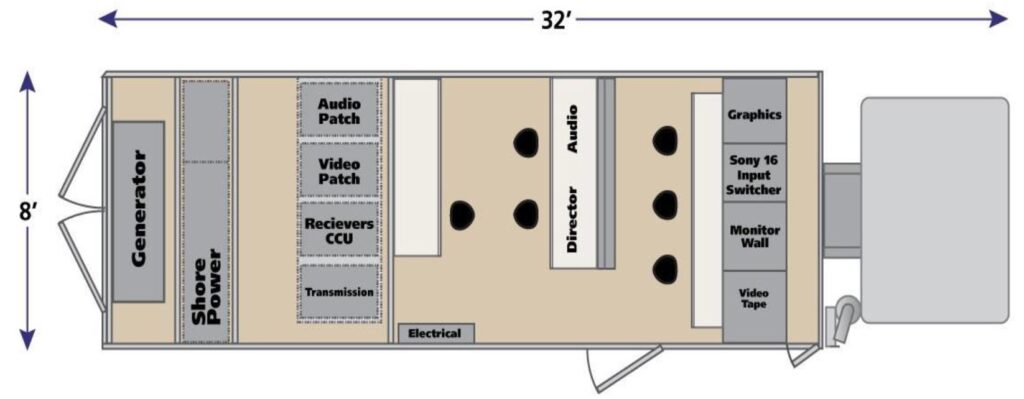
This is the layout of an extremely similar (just a bit newer) truck floor plan from the same conversion company. The oddly shaped black spots are chair locations for people working in the truck. It would have been tight, but it shows the capability.
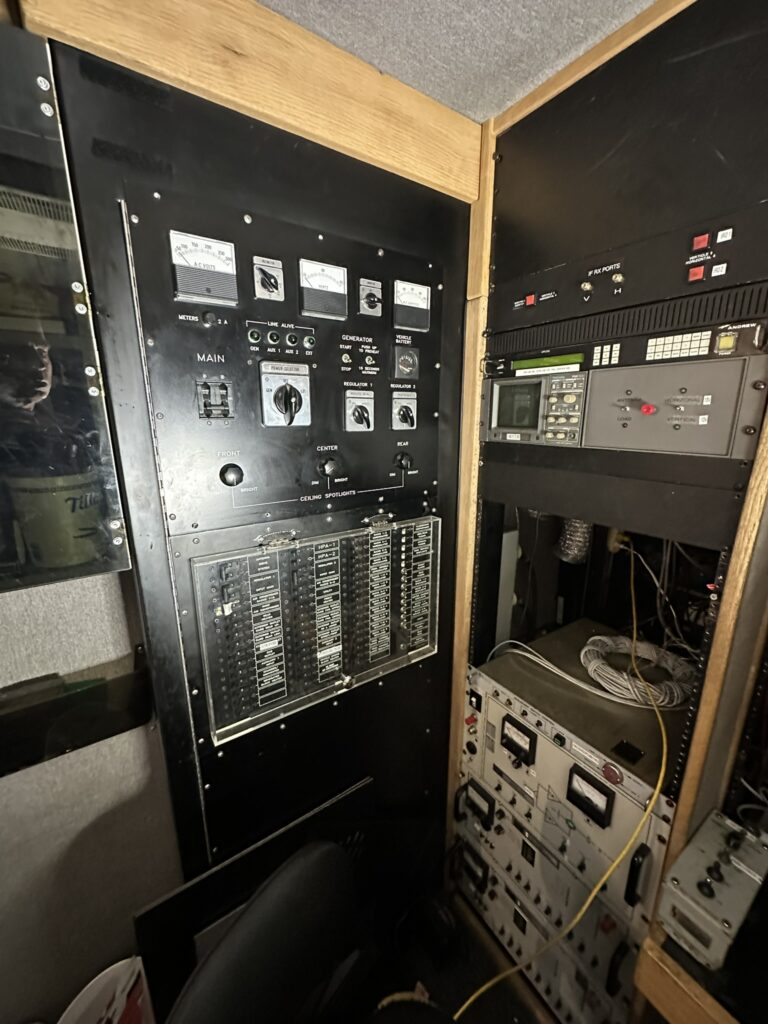
A detailed view of the power and RF control corner. The generator is fully remote controlled from this location. There are provisions for “shore” power switching. The TWT amplifiers are to the right in the bottom of the rack. The panel just above them is a selector switch assembly that allows selecting one amplifier, the other amplifier, or both amplifiers. Output selection to the waveguide continuing toward the dish or to a local 500w dummy load in the back of the rack. The upper portion of the rack selects horizontal or vertical feed as well as remote selection of transmit path to feed or another 500w dummy load in the feed assembly.
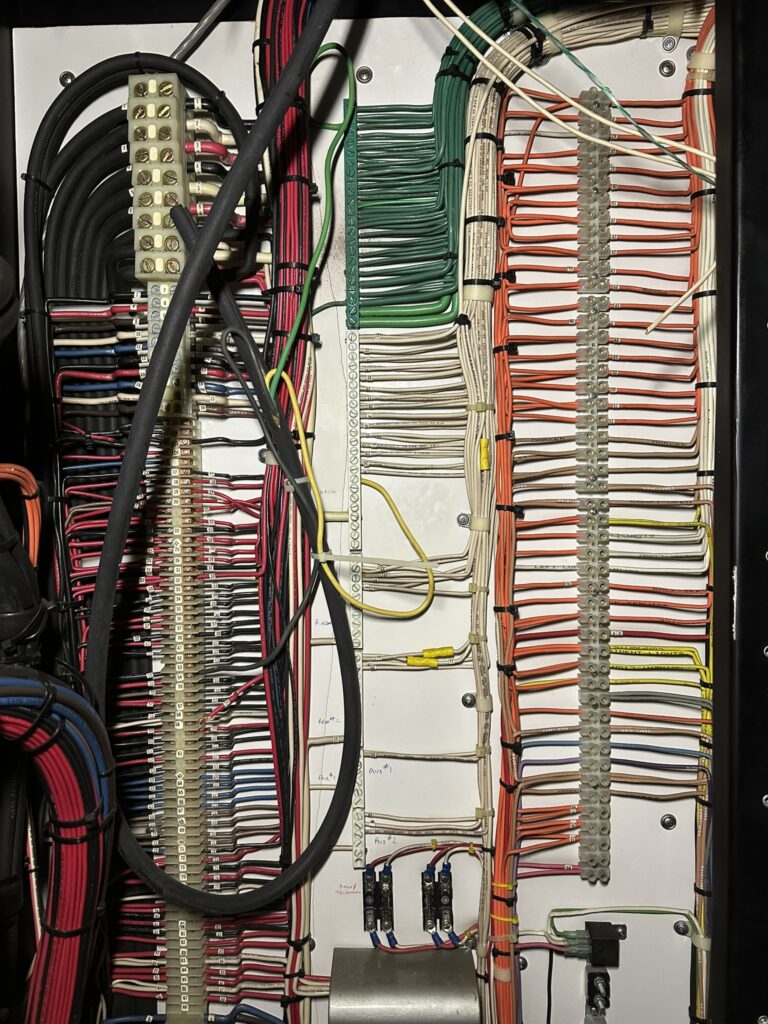
Inside view of the power distribution cabinet.
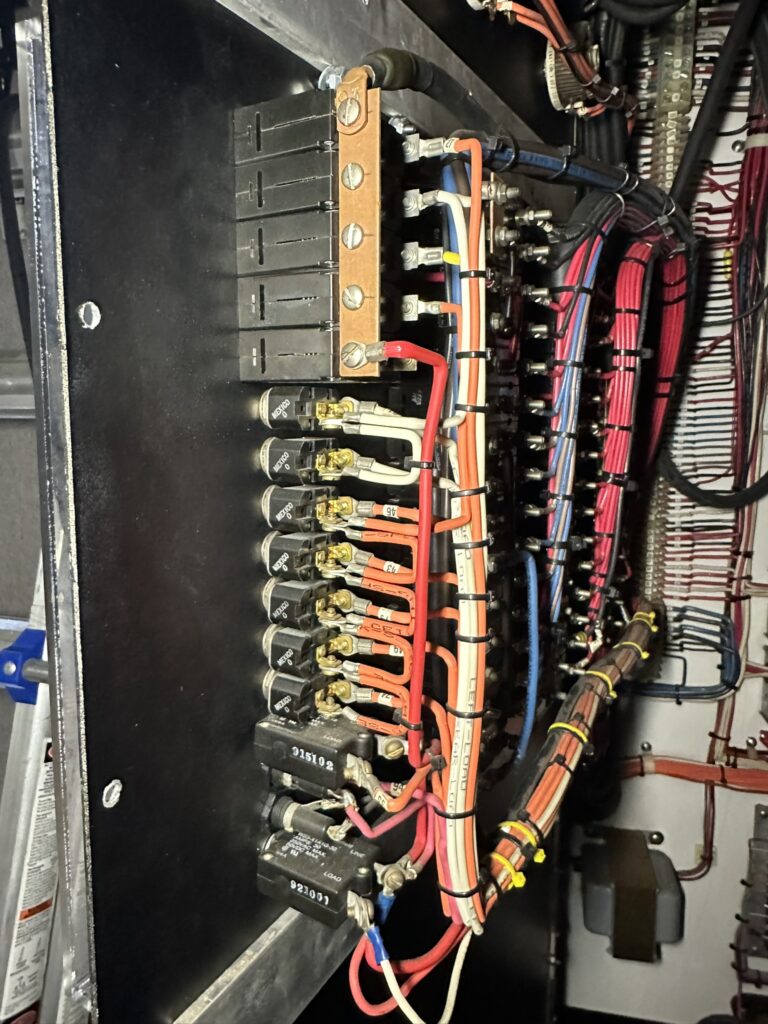
The two photos above show most of what it looks like behind the power control panels. There is a lot there. I’ve spent quite a bit of time learning where most of it all goes. I am not an expert yet. I am very thankful that it seems all well labeled and neatly installed. The photo immediately above is the back side of the power control and circuit breakers panel.
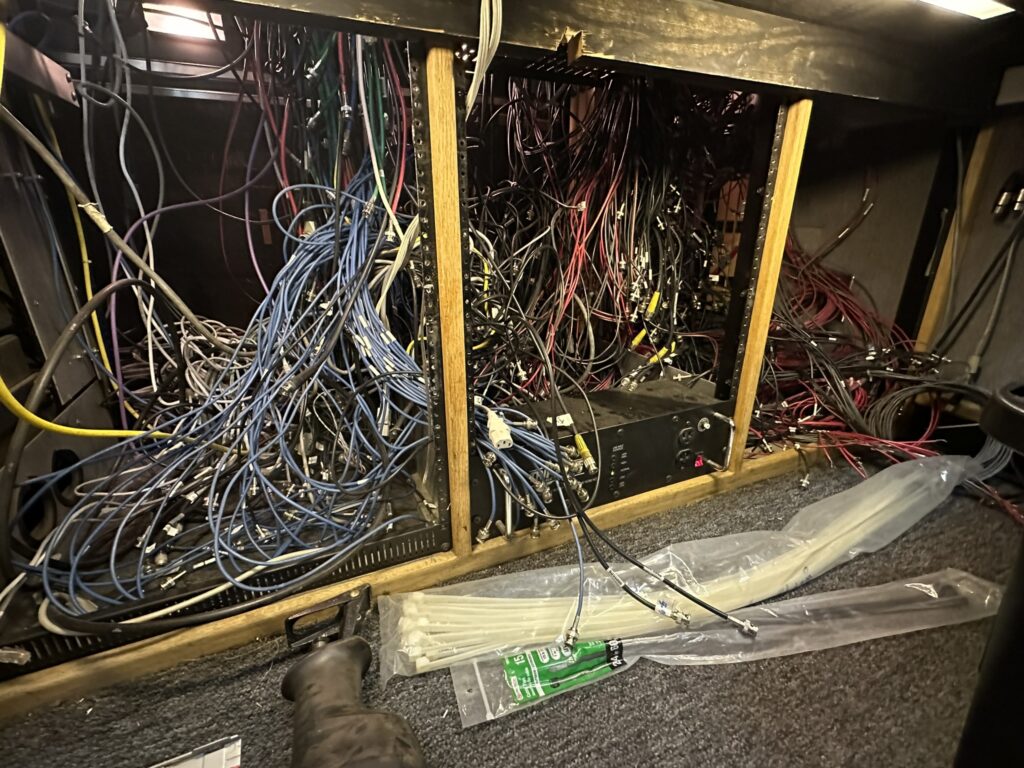
An example of the huge amount of cabling in the truck. I think I am a bit more than halfway through removing the excess cabling. A refit from analog video to digital HD video in the truck’s history caused a tangled mess.
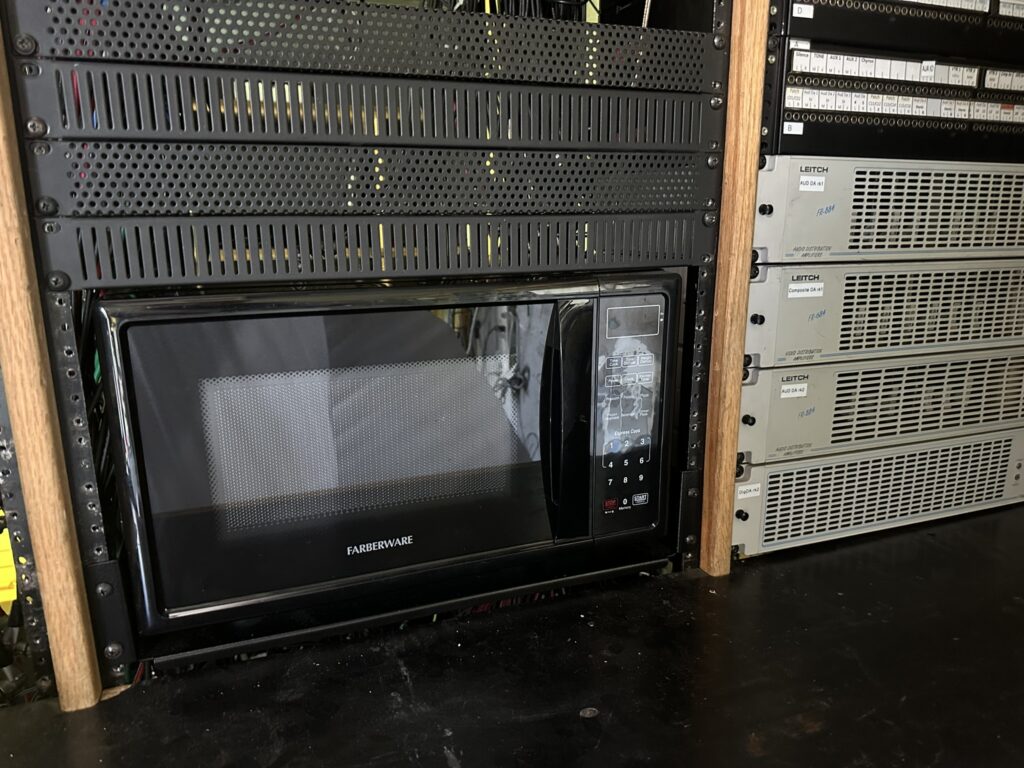
The photo I used when I had to prove to the insurance company that I had installed a way to do “food preparation” with a microwave oven. Insurance was the hard part. Climate control (heat & A/C), electric power, “food preparation”, and permanent sleeping accommodations will get me past the registration and license hurdle. In Oregon, all that is required is a simple affidavit from the owner. No inspection of the changes to the commercial truck are carried out. Just the affidavit. After I have the registration and title from Oregon, I can transfer it to Georgia. It’s a pity that the insurance cost will go up when I bring it to Georgia.
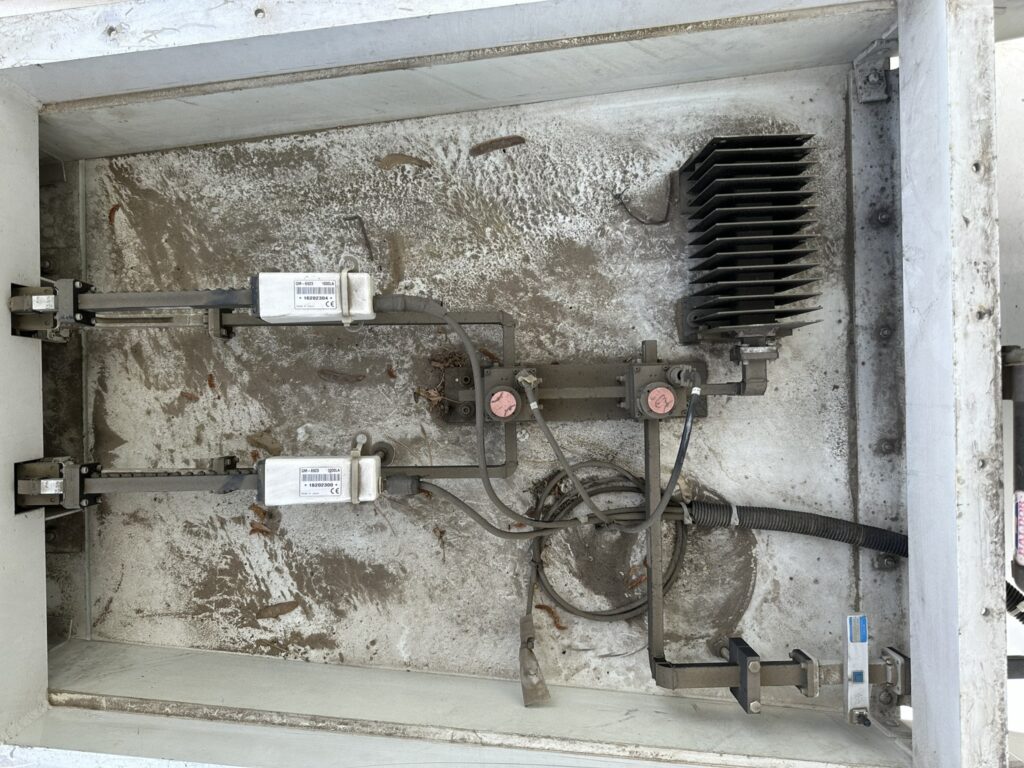
Current interior of the feed “sled”. The left side is at least 3 feet wide and the whole thing is at least 8 inches deep. There should be plenty of room for electronics near the feed point.
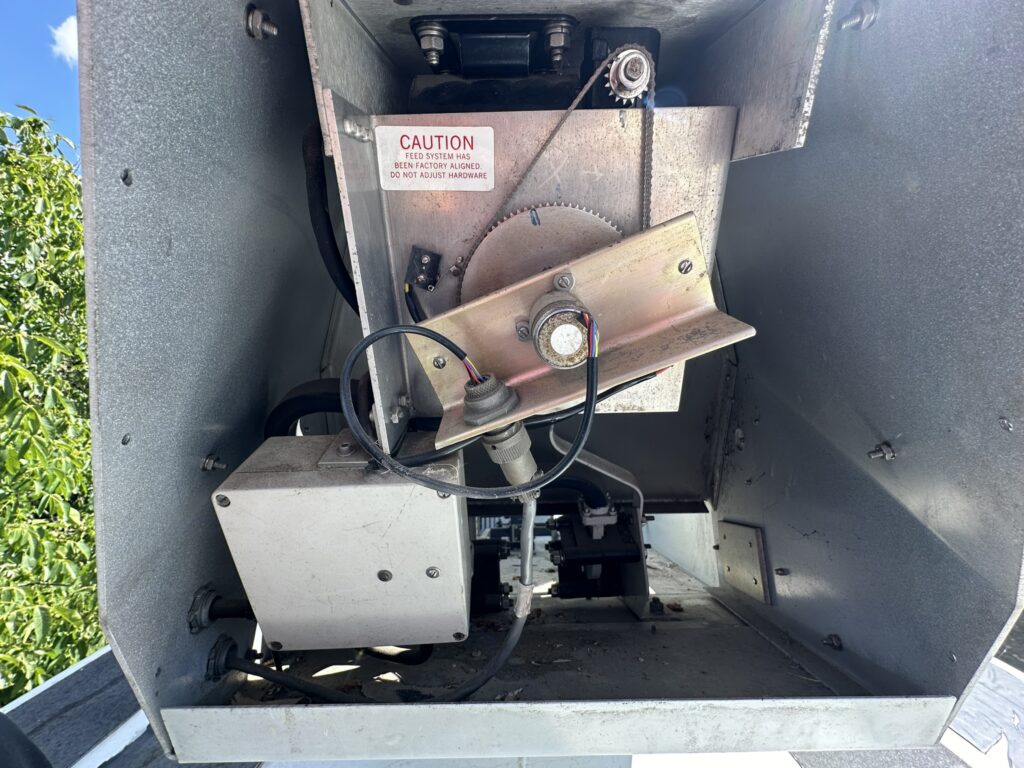
Inside the feed point shows the feed rotation axis motor and belt.
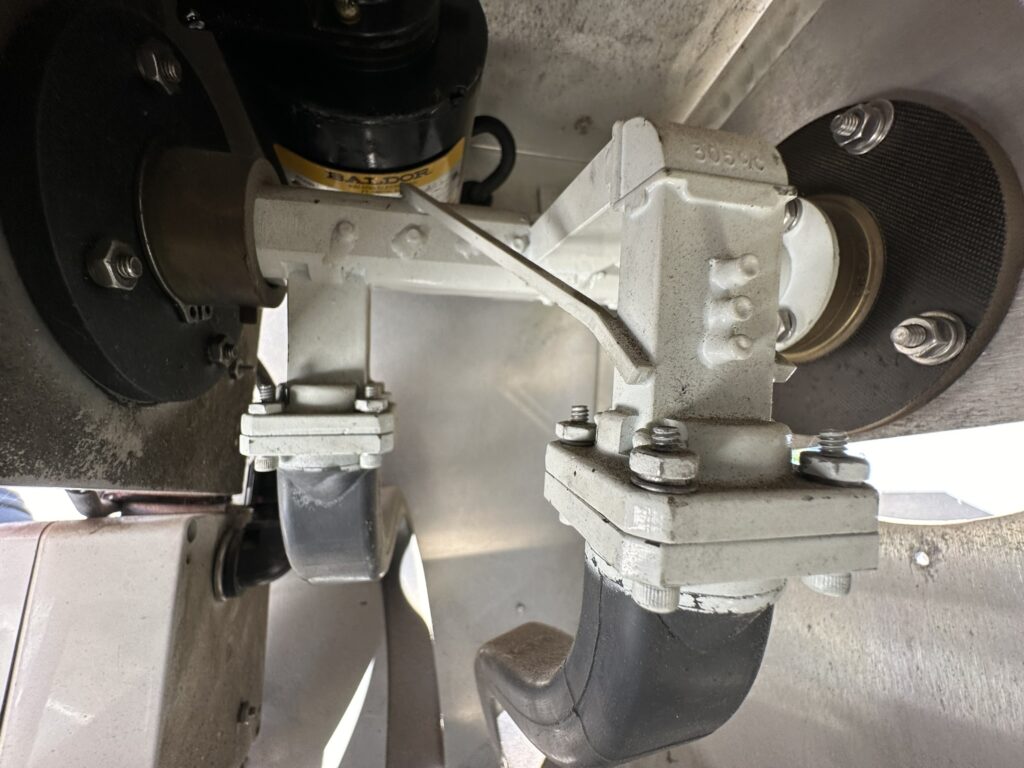
There are two flexible WR75 waveguides connecting the feed assembly. One is for horizontal and the other for vertical. The flexible sections allow for rotation. This should be useful on 10Ghz where most systems are set for linear polarization. I should be able to adjust for the polarization differential by at least +/- 45°. If this feed works, I can be horizontally or vertically polarized with the flip of a switch.
Things I do not know yet:
- How effective the existing feed is on 10GHz, if at all. I have one alternate feed, but it is not ideal on 10GHz.
- Are there any further road worthiness items that I have not yet planned for?
- How does this beast handle on the road?
- What is the MPG (miles per gallon) when driving? Or is it closer to gallons per mile? I have seen estimates of 8-10 MPG for similar trucks.
- How hard will it be to balance the driving fuel consumption with the generator consumption of 0.8 gallon per hour? I do not want to strand myself.
- How much trouble will it really be to adapt the antenna control system from what was used as a point to a single spot and leave it into tracking the moon?
- How can I easily get accuracy and precision down to what is needed to quickly and reliably get pointed onto the moon? I will need a pointing accuracy of 1/4° if this system is to work well. The moon at about 1/2° of arc is smaller than the 3db beamwidth of this dish at 10GHz. I have some ideas, but I would welcome constructive suggestions. This becomes a more complex equation when the truck might be at a different location each time.
It should be fun. I will not be bored in my retirement. Stay tuned for more information.
All I can say is,,, holy shit!! King of the 10GHz rovers.
Dave N9HF
el99